Who was `Abdu'l-Bahá, and why did He come to the West?


Monday, June 17, 2013

June 17, 1913 Egypt: A golden network of correspondence!


We don't have to be too sad about His departure from Europe, when we can visit Him in Egypt, for awhile: 

Earl Redman writes (in Abdu'l-Baha in Our Midst):

PORT SAID, ISMAILIA, ALEXANDRIA AND RAMLEH, EGYPT

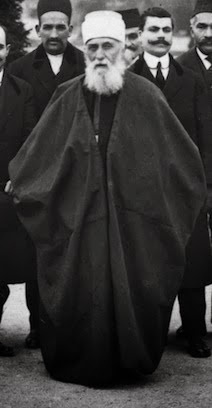
‘Abdu’l-Bahá arrived in Port Said on 17 June 1913. One of the first things He did was to send a telegram to Haifa, instructing the many pilgrims awaiting his return to come to Port Said. His hotel proved too small for the great crowds that appeared to see Him, so a large tent was erected on the hotel roof.
            ‘Abdu’l-Bahá also wrote to the Greatest Holy Leaf saying, ‘My eagerness knows no bounds. I have not seen thee for such a long time. My coming to Haifa is somewhat delayed. If possible, come soon to Port Said’. 
            The Master was very tired after almost three years of travelling. He stayed in Egypt until December, a span of five and a half months, trying to rebuild His physical strength before returning to Haifa, where a large amount of work awaited Him. It appeared He had little rest because ‘. . . pilgrims arrived constantly and had to be accommodated and entertained. He was never alone or free from demands. He could never refuse one who came to Him for whatever purpose’.  
            In spite of His exhaustion, ‘Abdu’l-Bahá continued to meet anyone who came. The pilgrims from Haifa occupied much of His time and His ever-increasing volume of correspondence consumed most of what was left. Ahmad Sohrab wrote about the Master’s endless letter writing:

The many difficult problems of the Bahai world are solved by him. Now he writes to Persia on how to hold an election, then to far-off America on how to rent a hall. One Bahai desires to know whether she should cook food for her child; another person asks how to proceed to buy a piece of land. There are some misunderstandings in this assembly to be removed; the feelings of some person are ruffled, and must be smoothed down. One man’s mother or father is dead, he requests a Tablet of visitation, another desires to have a wife. To one a child is born, she begs for a Bahai name; another has taught several souls, he asks for Bahai rings for them. This man has had business reverses, he must be encouraged, another has fallen from a ladder, he implores for a speedy recovery. One has quarrelled with his wife, and he wants advice on how to be reconciled; another supplicates for blessings upon his marriage. The Master goes over these one by one with infinite patience and with his words of advice, creates order out of chaos. The sorrows of the world troop along in review before him, and as they pass, lo, the transformation happens! The sorrowful becomes joyful, the ill-tempered good-natured, the lazy active, the sleepy one awakened. With magical words he transmutes iron into gold and darkness into light. At last he rises from his seat and for a while walks to and fro, still dictating Tablets to the philosopher and to the simple; soaring toward the empyrean of spirituality, giving us a vision of sanctity, and of the roses of Paradise, and for a while we roam, guided by him, in those delectable gardens of Abha, intoxicated with the fragrance of God; and then we find ourselves in the streets, walking home upborne on the wings of light.

But not all of ‘Abdu’l-Bahá’s correspondence was about personal desires. One day Ahmad Sohrab brought a large quantity of letters from Bahá’ís in America and Europe and the Master quite happily began dictating His replies. Ahmad described how ‘Abdu’l-Bahá dictated:

. . . the words of wisdom like unto a sparkling stream flowed from his blessed mouth, he was a transfigured person. He sat immovable on the sofa, his eyes most of the time shut, but his heart a waving ocean of revelation. Now he revealed a Tablet to a believer in Constantinople, and again to a friend in Rangoon, India; Stuttgart and Switzerland, London and Paris, New York and Honolulu, Washington and Boston were represented. How wonderful and significant appears to me this golden network of spiritual correspondence, reaching to the different parts of the earth! This correspondence is not based upon any commercial or material scheme. It is the eternal plan of God, to diffuse the fragrance of the spiritual rose and scatter the rays of the Divine Sun! Every day an ideal Congress of religions and nations is held in the rather small room of the Beloved and he presides over the proceedings with a dignity and wisdom that is nothing short of miraculous . . . Toward the end, the Master was so moved that he got up from his seat and began to walk to and fro while continuing dictation. I tried to keep up with the rapidity of his uttered words. When I mentioned the name of one of the believers, his whole countenance changed, and he was very happy, saying that he loved him, because he was very sincere in the Cause.
__________
Wouldn't we love to change the countenance of the Master--as a result of our own sincerity!  And isn't that a wonderful image--a golden network of spiritual correspondence! 


Thursday, June 13, 2013

June 12, 1913 The End of the Western Sojourn

Oh--is it true? Have we reached the end of His western sojourn?  Of course, He doesn't return to Haifa until December 5, 1913--a full year since departing from America.  I am strangely affected and unaffected at the same time--since He is always present with us, transcending either coming or going.

Earl Redman writes: 

‘Abdu’l-Bahá and His party left the hotel [in Paris] at 8 o’clock in the morning of 12 June for the train station. After some final words to His followers, urging them to be united, He departed for Marseilles. Twelve hours later He reached the city, then left the following morning at 9 a.m. aboard the steamer Himalaya, bound for Egypt.
_______

Where is Mahmúd's volume 2 when we need it? Oh, for more details. What were His final words?

Since I did not cover the first European journey in this blog, I will put an earlier story here, in the absence of details re. this departure from Paris.


Earl Redman writes: 
Two days before ‘Abdu’l-Bahá left Paris, a woman came anxiously into a gathering at the Avenue de Camöens. Breathlessly, the woman said:

Oh, how glad I am to be in time! I must tell you the amazing reason of my hurried journey from America. One day, my little girl astonished me by saying: ‘Mummy, if dear Lord Jesus was in the world now, what would you do?’ ‘Darling baby, I would feel like getting on to the first train and going to Him as fast as I could’. ‘Well, Mummy, He is in the world’. I felt a sudden great awe come over me as my tiny one spoke. ‘What do you mean, my precious? How do you know’, I said. ‘He told me Himself, so of course He is in the world’. Full of wonder, I thought: Is this a sacred message which is being given to me out of the mouth of my babe? And I prayed that it might be made clear to me.
      The next day she said, insistently and as though she could not understand: ‘Mummy darlin’, why isn’t you gone to see Lord Jesus? He’s told me two times that He is really here, in the world’. ‘Tiny love, Mummy doesn’t know where He is, how could she find Him?’
      ‘We see, Mummy, we see’.
      I was naturally perturbed. The same afternoon, being out for a walk with my child, she suddenly stood still and cried out, ‘There He is! There He is!’ She was trembling with excitement and pointed at the window of a magazine store where there was a picture of ‘Abdu’l-Bahá. I bought the paper, found this address, caught a boat the same night, and here I am. [i]

On 1 December, ‘Abdu’l-Bahá said goodbye to Europe:

I bid a loving farewell to the people of France and England. I am very much pleased with them. I counsel them that they may day by day strengthen the bond of love and amity to this end – that they may become the sympathetic embodiment of one nation – that they may extend themselves to a universal Brotherhood to guard and protect the interests of all the nations of the East – that they may unfurl the Divine Banner of justice – that they may realize and treat each nation as a family composed of the individual children of God and may know that before the sight of God the rights of all are equal . . .
      Beware! Beware! Lest ye offend any heart.
      Beware! Beware! Lest ye hurt any soul.
      Beware! Beware! Lest ye deal unkindly toward any person.
      Beware! Beware! Lest ye be the cause of hopelessness to any creature.[ii]


[i] ibid. p. 185.
[ii] Star of the West, vol. II, no. 16 (31 December 1911), p. 6.
___________

So now we are at the departure of 1913--and He will never again be in Europe or North America--except that, of course, He is always here--and everywhere. 

What a blessing it has been to recount the Travels of One who remains a Mystery, eternally. And to grow just a wee bit closer to Him.  

Sunday, June 9, 2013

June 6, 1913 Visits of former enemies

Well, I missed posting this on June 6--I think I am dragging my heels a bit because I don't want 'Abdu'l-Bahá to leave the West. (Do you realize that on June 12th He'll be going back to Egypt--and from there back to Haifa on Dec. 5?) Of course, his family and others were surely missing Him. And news must have travelled very slowly. No blogs, email, or texting back then, you know. Ok, back to Paris:

Earl Redman writes: 

‘Abdu’l-Bahá’s final days were marked by the humble visits of a number of former enemies. On 6 June He was visited by Ahmad ‘Izzat shá, who had been Sultán Abdu’l-Hamid’s chief counsellor before the Ottoman Empire succumbed to the Young Turks. He had escaped Turkey ahead of the rebellion. Now, he gave a dinner party for ‘Abdu’l-Bahá. A couple days later, a Persian prince stopped by ‘Abdu’l-Bahá’s hotel. The prince acted in an arrogant manner until the very humble Ahmad ‘Izzat Páshá arrived and, by his attitude of complete deference to the Master, taught the upstart an important lesson.
            

Saturday, June 1, 2013

June 1, 1913 Pilgrims awaiting His return

Earl Redman writes: 

On 1 June Mírzá ‘Alí-Akbar Nakhjavání, who had accompanied the Master during his visit to America, arrived from Haifa and told ‘Abdu’l-Bahá that there were many pilgrims awaiting His return.

________

This man is the father of Ali Nakhjavani!  There are some great photos of him with 'Abdu'l-Baha, especially at Green Acre. I can just imagine how loyal he must have felt toward the Master. 
           

May 27, 1913 A new hotel in Paris; story of a poor man

I'm late with this, but it's a marvelous story--so read on!

Earl Redman writes: 

On 27 May ‘Abdu’l-Bahá moved to a new hotel on Rue Lauriston where He was forced to rest for several days. The hotel food did not suit the Master so the Dreyfus-Barneys and Ahmad shá cooked for Him at their homes, though He asked them not to do so.
            As always, the poor were just as attracted to ‘Abdu’l-Bahá as were the rich, but didn’t always have the same reception. This wasn’t due to ‘Abdu’l-Bahá, but to those around Him. At one of the hotels the Master stayed in while He was in Paris, a poor black man came to see Him. The man was not a Bahá’í, but was completely in love with the Master. When the man tried to enter the hotel, someone told him that the management of the hotel did not want him there because ‘it was not consistent with the standards of the hotel’. The man was forced to leave. When ‘Abdu’l-Bahá learned of this, He was very unhappy and called for the person responsible, whom He immediately sent off to find the rejected man and to bring him to His Presence. Said the Master, ‘I did not come to see expensive hotels or furnishings, but to meet My friends. I did not come to Paris to conform to the customs of Paris, but to establish the standard of Bahá’u’lláh‘.[iii]
            

Sunday, May 26, 2013

May 23, 1913 Deflecting His own birthday . . .

Earl Redman writes: 
       
 The next day was the celebration of the Declaration of the Báb. Many people arrived, however, with flowers to celebrate the Master’s birthday. He told them that it was inappropriate to celebrate His birthday on a day of much greater import – the Declaration by the Báb of His Mission to Mullá Husayn.           
_______

(Sorry this post is late. . . . Focused on the film.  I will post my own reflections from last year's blog post, below.  AP)


Even though the following occurred on the evening of May 23, since we now customarily celebrate the Declaration of the Báb on the night of the 22nd, I will post this reflection today.
Mahmúd chronicles the story of the birthday of 'Abdu'l-Bahá on May 23, 1912 as follows:
[After His talk at Clark University] "He returned to Boston in the automobile especially provided for Him by the chancellor. The Master went directly to the home of Mrs Alice Breed. As that evening was the commemoration of the Declaration of the Báb as well as the birthday of `Abdu'l-Bahá, the Bahá'ís, with the utmost happiness and joy, had arranged a magnificent feast. When `Abdu'l-Bahá arrived, He rested for awhile and then joined the gathering of the friends, illuminating the meeting with His presence. With joyful and shining faces, all eyes were directed towards the Master. The freshness and verdure of that gathering was like a flower garden and was proof that the Tree of the Cause of God has been firmly rooted in American soil and that it has produced leaves and blossoms of the utmost beauty. The Master spoke briefly about the greenery of the surrounding countryside, the magnificence of the city of Boston, as well as the university. He then gave an account of the life of the Báb that gladdened the hearts and cheered the souls.
     Tea, drinks and sweets were served in another room. Mrs Breed brought before the Master a birthday cake with 68 candles, representing His age. At her request, He lit the first candle and then each of the friends in turn lit a candle, each person like a moth burning with the fire of love. When the cake was cut, each guest took a slice as a sacred relic. Mrs Breed, indeed, lit the candle of servitude and steadfastness that evening and, in doing so, became the recipient of bounty from `Abdu'l-Bahá's presence."

Rob Stockman in his forthcoming book about `Abdu’l-Bahá in America describes Alice Breed as one of the most active Bahá’ís in the Boston area. (She was also the mother of Florence Breed, who married Ali Kuli Khan.) In Rob's words, Alice "had baked a birthday cake for `Abdu’l-Bahá, complete with American, Persian, and English flags and sixty-eight candles, and had invited over a hundred guests. Since `Abdu’l-Bahá was born on the same day that the Báb inaugurated His mission in Iran, and the Declaration of the Báb was a Bahá’í holy day, some years earlier `Abdu’l-Bahá had instructed the Bahá’ís not to celebrate His birthday. He had even expressed His objection explicitly to Alice’s son in law. According to Marzieh Gail, Breed’s granddaughter, “He did not stay for the festivities. . . . In His address He spoke only of the Báb’s Declaration on this day, saying not a word about Himself. Afterward, Alice persuaded Him to step into the dining room and at least see the festive table and the cake, and take a little refreshment. He sat in the large, brocaded ‘grandfather’ chair but soon left.” [Arches of the Years, 89] Mahmúd adds that `Abdu’l-Bahá lit the first candle on His cake and asked everyone else to take turns lighting the others.”

The BOSTON HERALD noted: "It was the wish of ‘Abdu’l-Bahá to have a flag of every country on the cake, as he is universal, and considers every country his own, but there was not room for all."
ah, the Mystery of God!  To be born on the very day and time of the Declaration of the Báb has a significance we cannot grasp. Then, for us to have a yearning to celebrate `Abdu’l-Bahá's birthday (can you imagine being in His midst on this day?) but to be discouraged by His own objections . . . 

It seems this story has a lesson for us. Can you imagine the excitement of Alice Breed as she prepares for the feast, the cake, the flags, the candles. . . . And then for the Guest of honor to feel disquieted (we can assume) about the attention and the focus upon His birthday--and then to excuse Himself.  It makes me wonder if Alice wrote her memoirs and mentioned this incident.  Or what `Abdu’l-Bahá might have told Mahmud or others afterwards. 

Of course we now have the Day of the Covenant to celebrate His life (in November, near the Ascension of `Abdu’l-Bahá) but again, the focus is not on His birthday but on his role within the Cause--as Center of the Covenant.  While we are eager to celebrate Him, He downplays His person, with humility. 

Isn't it curious that out of 11 Baha'i holy days, only 9 are days on which Baha'is should suspend work? The other two--those related to `Abdu’l-Bahá--are not in that same category. 

In 1912 many, no doubt, wanted to laud `Abdu’l-Bahá as a prophet figure, but He was always reminding His hearers of His servitude.  Thus, He would want us to remember the Bab's life and station on this evening and tomorrow, even when we were / are caught up in `Abdu’l-Bahá's presence.  

Like Alice, I would have probably been one of those to commit a faux pas and gone overboard with a desire to celebrate Him--only to realize later the significance of His instructions. . . . Would you?

Oh, the lessons.

Wednesday, May 22, 2013

May 22, 1913

Earl Redman writes: 

Rashíd Páshá and the Persian Minister paid the Master another visit. On 22 May He Himself visited a member of the Persian aristocracy, who was overwhelmed, bowing and kissing the Master’s hand. This man, very important in other circles, related a story about how he had lost his hostility toward the Bahá’í Faith. He found himself one day sitting next to a woman in London and was intrigued by her inexpensive but beautiful ring. When he asked about it, the woman replied that since he was a Persian, surely he could read the name of Bahá’u’lláh inscribed on the stone. At that, he felt very ashamed, but then quite elated when he realized that here was evidence of Persia’s influence in London. At that moment, he realized that he no longer harboured any hostility toward the Faith of Bahá’u’lláh.[ii]
    

[i] Balyuzi, ‘Abdu’l-Bahá, p. 391.
[ii] ibid. p. 394.
[iii] Star of the West (The Bahá’í Magazine), vol. 16, no. 5 (August, 1925), p. 528.
[iv] ibid. p. 395.